DS'25
Array & Differentiable Programming
Compilers for machine learning: derive and prove what ML frameworks hard-code.
Machine learning runs on a small set of operations (multiply these arrays, differentiate this, invert that) that a compiler ought to derive rather than have a human write out by hand. My work gives these transformations a functional foundation, so they can be optimized aggressively and proved correct rather than trusted.
- Arrays: a normal form for array programs in which partial evaluation and common subexpression elimination become one algorithm (ECOOP'24).
- Derivatives: automatic differentiation optimized by rewrite strategies, with Timon Böhler (FTfJP'23).
- Inverses: a verified search for inverse functions, applied to normalizing flows, with Timon Böhler and Benedict Smit (preprint).
Highlight
- 🏅 Distinguished Paper Compiling with Arrays, ECOOP 2024
Collaborators
Timon Böhler
Jannis Brugger
Mattia Cerrato
Cedric Derstroff
Stefan Kramer
Daniel Maninger
Mira Mezini
Viktor Pfanschilling
Benedict Smit
Pascal Weisenburger
Timeline
2023FTfJP @ ECOOP · Short paper
Using Rewrite Strategies for Efficient Functional Automatic Differentiation
Automatic differentiation with dual numbers is close to the textbook definition of a derivative and easy to prove correct, but slow, and the optimizations that fix this are order-dependent. Expressing them as rewrite rules controlled by a strategy language keeps the elegance of dual numbers while stating the optimization schedule separately. On a micro-benchmark, the rewrites optimize away the nested loops of a gradient entirely (preliminary results).
Links: FTfJP 2023 · paper · arxiv
2024ECOOP
Compiling with Arrays
Typed partial evaluation is powerful but unsafe for array code: substituting a variable used twice duplicates work, and common subexpression elimination is defeated by the scopes that nested lets, loops and branches introduce. Reading arrays as the positive dual of the function type (from polarized type theory) yields AiNF, an intermediate representation whose terms are flat and maximally fissioned, so both optimizations combine into one algorithm. Termination, type preservation and maximal fission are mechanized.
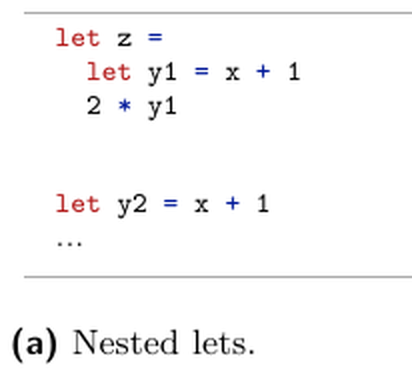
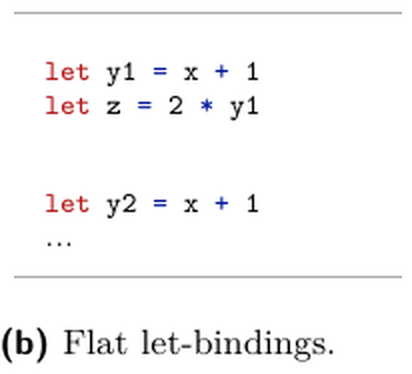
Fig. 1a/1b from the paper: y1 is redundant with y2, but it is not in scope at y2's definition (until the program is flattened).
Links: ECOOP 2024 · paper · artifact · github · arxiv 🏅 Distinguished Paper
2026Unpublished draft (click to expand)Verified Inverse Function Search for Normalizing Flows
Verified Inverse Function Search for Normalizing Flows
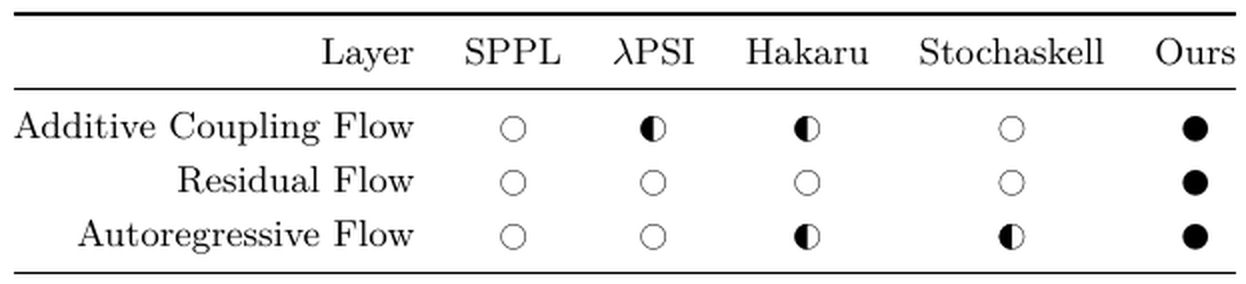
Probabilistic modeling libraries make you write each transformation and its inverse by hand, and classical program inversion demands a local invertibility that ML code lacks. Treating inversion as a search for a path that recovers the inputs by composing partial inverses (semi-inversion), with the algorithm and its soundness proof mechanized in Lean, synthesizes inverses for standard normalizing flows (additive coupling, residual, autoregressive) that existing probabilistic-programming tools fail to invert.
Links: preprint
In collaboration: equation discovery
The same idea, run backwards: instead of compiling learning, use learning to search for a program (the equation behind a data set). A neural network proposes the shape of a law, and symbolic search fills in the details.
2025
Neural-Guided Equation Discovery. Brugger, Cerrato, Richter, Derstroff, Maninger, Mezini, Kramer. Preprint. arxiv
Open questions
Directions that come out of the work above, from thesis-sized (BSc/MSc) to PhD-scale:
- Differentiation in AiNF. Extending the array language with automatic differentiation, proved correct, and using its optimization to remove the redundancies that differentiation generates.
- Probabilistic primitives. Adding them to the same array language, again with correctness proofs.
Useful background is functional programming and some Lean or Scala; my Type Systems lecture covers the foundations. If one of these interests you, write me an email.